

Decadent Politics
Thursday 6 November: 18:00-20:00 (hybrid: in person and online)
PSH LG01, Goldsmiths, University of London
Chaired by Adam Alston, with Alex Murray (QUB), Shushma Malik (Cambridge), Alan Finlayson (UEA), and Neville Morley (Exeter)
Roundtable to discuss Alex Murray’s Decadent Conservatism: Aesthetics, Politics, and the Past
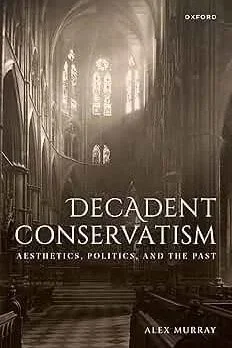
Alex Murray’s Decadent Conservatism offers the first in-depth examination of the intersection of literary Decadence and conservatism, arguing that underpinning both was the desire to find alternatives to liberal modernity. Yet this is not the whole story when it comes to the intersection of decadence (as a historiographical concept) and politics.
This event draws together scholars from literary studies, classical studies and political theory to examine the broader ways in which decadence has been used as a key term in the political discourses of modernity. Ranging from the reception of classical antiquity in the nineteenth century through to the contemporary spate of jeremiads against civilizational decline by those on the right, the contributors interrogate the assumptions implicit in the use of decadence as a political diagnostic. Some of the questions considered will be: can there be a radical, left-wing use of the concept of decadence? Is the use of decadence in politics a surefire symptom of a culture in decline? Is decadence really just a synonym for change by those who cannot accept it? Is the destruction of the institutions of liberal democracy the height of decadence? How does contemporary decadent art respond to a culture of conservatism?
Alex Murray is Professor of Modern Literature at Queen’s University Belfast and founding co-editor of Cusp: Late 19th-/Early 20th-Century Cultures (Johns Hopkins University Press). His most recent books include Decadent Conservatism: Aesthetics, Politics, and the Past (Oxford University Press, 2023) and with Kate Hext The Oxford Handbook of Oscar Wilde (Oxford University Press, 2025). He is currently a Visiting Fellow at All Souls College, Oxford where he is editing Conservatism and Literary Studies for Cambridge University Press and working on his fifth monograph, ‘Creativity and Critique: English Literary History at the fin de siècle’, which is funded by a Leverhulme Research Fellowship.
Alan Finlayson is Professor of Political & Social Theory at the UEA. His main interests are in the history of political ideas and political ideologies, and in rhetoric as a tradition of theory, a method for analysing political ideas and a part of the art of politics. He has recently published a co-authored book about the history of English protest songs, and recommends that everyone go to the website www.oursubversivevoice.com to find out more. But his main research interest is how digital platforms have transformed political rhetoric, with a particular focus on ‘Reactionary Digital Politics’.
Shushma Malik is Associate Professor in Classics at the University of Cambridge. She has research expertise in imperial Rome and its reception, and is author of The Nero-Antichrist: Founding and Fashioning a Paradigm (Cambridge University Press, 2020). She has published book chapters and articles on Oscar Wilde, religion, and Roman emperors, as well as on Rome and decadence more broadly, including a contribution to the volume Cambridge Critical Concepts: Decadence and Literature (eds. J. Desmarais and D. Weir) in 2019, and the Oxford Handbook of Decadence (eds. J. Desmarais and D. Weir) in 2021.
Neville Morley is Professor of Classics & Ancient History at the University of Exeter. His research and teaching cover both the economic, social and intellectual history of ancient Greece and Rome, with a particular focus in recent years on historiography and political thought, and the modern reception of classical antiquity, especially Thucydides and the idea of ‘decadence’. He is currently a Leverhulme Major Research Fellow, working on a project on Marx, Class and Classical Antiquity.
Adam Alston is Reader in Modern and Contemporary Theatre at Goldsmiths, University of London. He runs the Staging Decadence project (www.stagingdecadence.com), and is Co-Deputy Chair of the Decadence Research Centre. He is the author of Staging Decadence: Theatre, Performance, and the Ends of Capitalism(2023), co-editor (with Professor Jane Desmarais) of Decadent Plays: 1890-1930 (2024), and co-editor (with Dr Alexandra Trott) of a special issue of Volupté: Interdisciplinary Journal of Decadence Studies on ‘Decadence and Performance’ (2021). He has also published extensively on immersive and participatory theatres.
Attendance is free and there is no need to register. If you would like to attend remotely, please email drc@gold.ac.uk
Location
The Professor Stuart Hall Building is opposite the Richard Hoggart Building on the other side of the College Green.
Follow the path around the College Green next to the Whitehead Building
Walk up the steps and the entrance to the PSH will be in front of you
Go into the building and take the steps down to the lower ground floor. PSH LG01 is in front of you on the left.
Goldsmiths is located in New Cross, South East London. It is a short walk from both New Cross Gate and New Cross stations (Zone 2) on the main rail network and London overground; about a 7 minute journey from London Bridge and 30 minutes from London Victoria. It is on bus routes 21, 36, 53, 136, 171, 172, 177, 225, 321, 343, 436, 453.
For exact directions to Goldsmiths please see the How to Find Us page on the Goldsmiths website.
For more information about these events, please email drc@gold.ac.uk.